

Le MCC / Pax Romana – SIIAEC à la « Conférence Internationale du Travail » (CIT) (8 Juin 2018, Genève)
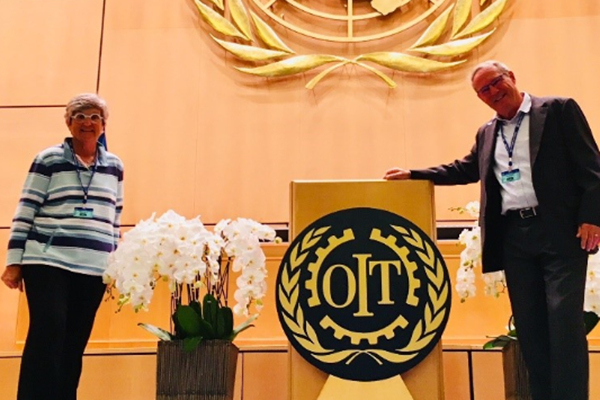
Le MCC / Pax Romana – SIIAEC à la « Conférence Internationale du Travail » (CIT)
En route vers 2019 et le début de son « deuxième centenaire », l’OIT tient, à Genève, du 28 mai au 8 juin, l’Assemblée Générale de ses 187 Nations. L’ordre du jour part d’un constat clair : dans un monde du travail en évolution rapide, passer de l’indignation à l’action pour une mondialisation et une croissance économique plus équilibrées, sources de travail décent pour toutes et tous.
Deux Commissions en portent particulièrement les enjeux : « Violence et harcèlement contre les femmes et les hommes dans le monde du travail » et « Dialogue social tripartite pour une mondialisation équitable ».
Les formes de « Harcèlement » et de « Violences » se diversifient rapidement : physique, sexuelle, psychologique, morale; mais aussi: la pression des rythmes de travail, des hiérarchies « destructurées », des déroulements de carrières (et mises à la retraite forcées). Ces sources de violences peuvent être directes ou « numériques » (y-compris maintien sous contrainte hors heures de travail) et touchent jusqu’aux chercheurs d’emploi / stagiaires / apprentis / bénévoles.
La question-clef du débat tripartite de l’OIT (chaque pays est représenté par 3 délégations : Gouvernement, Employeurs, Travailleurs) est donc celui du large champ d’application de la future Convention Internationale à faire ratifier. Comment couvrir, à la fois, ce qui se passe sur les lieux et dans les heures de travail et ce qui s’y joue « ailleurs et plus tard » ? Comment couvrir les travailleurs de l’économie informelle, à la fois les plus exposés et les moins protégés ?
Les défis modernes du « Dialogue Social » de leur côté, se heurtent à la difficulté de plus en plus fréquente d’identifier le « véritable employeur » avec qui discuter. Qui est réellement le « Patron » lorsque le pouvoir de la finance est omni-présent? Qui est le vrai « Décideur » dans une longue chaine de sous-traitance internationale qui finit dans des pays à bas salaires mais sans réglementation ? Avec qui « dialoguer » lorsque je suis travailleur « indépendant / auto-entrepreneur », « journalier ou saisonnier », « transfrontalier », « migrant », ou « informel » ?
Sachant la nécessité d’entretenir le « dialogue social » comme investissement collectif de long terme, basé sur la sincérité, confiance et désir de construire ensemble, ces questions poussent l’OIT à constamment adapter ses normes, fidèle à sa mission mondiale de « PARLEMENT de la PAIX UNIVERSELLE et DURABLE par la JUSTICE SOCIALE ».
Genève, 1er juin 2018
Jocelyne et Bruno BOULNOIS
Sec Gal SIIAEC et Responsables à l’International du MCC
Traducir:
MCC / Pax Romana – SIIAEC at the “International Labour Conference” (ILC) (8 June 2018, Geneva)
On its way to 2019 and the beginning of its “second centenary”, the ILO is holding the General Assembly of its 187 Nations from 28 May to 8 June in Geneva. The agenda starts from a clear statement: in a rapidly changing world of work, moving from outrage to action for more balanced globalization and economic growth, sources of decent work for all.
Two Commissions focus on the issues: “Violence and harassment against women and men in the world of work” and “Tripartite social dialogue for a fair globalization”.
The forms of “Harassment” and “Violence” are rapidly diversifying: physical, sexual, psychological, moral; but also: the pressure of work rhythms, “destructured” hierarchies, career sequences (and forced retirements). These sources of violence may be direct or “digital” (including forced confinement outside working hours) and affect job seekers / trainees / apprentices / volunteers.
The key issue of the tripartite ILO debate (each country is represented by 3 delegations: Government, Employers, Workers) is therefore the broad scope of the future International Convention to be ratified. How to cover both what is happening on the premises and in working hours and what is being done “elsewhere and later”? How to cover workers in the informal economy, both the most exposed and the least protected?
The modern challenges of the “Social Dialogue”, on the other hand, come up against the increasing difficulty of identifying the “real employer” with whom to discuss. Who is really the “Boss” when the power of finance is omni-present? Who is the real “decision-maker” in a long chain of international subcontracting that ends up in low-wage countries but without regulation? With whom to “dialogue” when I am an “independent / self-employed” worker, “everyday or seasonal”, “cross-border”, “migrant”, or “informal”?
Knowing the need to maintain “social dialogue” as a long-term collective investment, based on sincerity, trust and the desire to build together, these issues push the ILO to constantly adapt its standards, true to its global mission of “PARLIAMENT OF UNIVERSAL and SUSTAINABLE PEACE through SOCIAL JUSTICE “.
Geneva, 1st June 2018
Jocelyne and Bruno BOULNOIS
Sec Gal SIIAEC and MCC International Leaders
MCC / Pax Romana – SIIAEC at the “International Labour Conference” (ILC) (8 June 2018, Geneva)
On its way to 2019 and the beginning of its “second centenary”, the ILO is holding the General Assembly of its 187 Nations from 28 May to 8 June in Geneva. The agenda starts from a clear statement: in a rapidly changing world of work, moving from outrage to action for more balanced globalization and economic growth, sources of decent work for all.
Two Commissions focus on the issues: “Violence and harassment against women and men in the world of work” and “Tripartite social dialogue for a fair globalization”.
The forms of “Harassment” and “Violence” are rapidly diversifying: physical, sexual, psychological, moral; but also: the pressure of work rhythms, “destructured” hierarchies, career sequences (and forced retirements). These sources of violence may be direct or “digital” (including forced confinement outside working hours) and affect job seekers / trainees / apprentices / volunteers.
The key issue of the tripartite ILO debate (each country is represented by 3 delegations: Government, Employers, Workers) is therefore the broad scope of the future International Convention to be ratified. How to cover both what is happening on the premises and in working hours and what is being done “elsewhere and later”? How to cover workers in the informal economy, both the most exposed and the least protected?
The modern challenges of the “Social Dialogue”, on the other hand, come up against the increasing difficulty of identifying the “real employer” with whom to discuss. Who is really the “Boss” when the power of finance is omni-present? Who is the real “decision-maker” in a long chain of international subcontracting that ends up in low-wage countries but without regulation? With whom to “dialogue” when I am an “independent / self-employed” worker, “everyday or seasonal”, “cross-border”, “migrant”, or “informal”?
Knowing the need to maintain “social dialogue” as a long-term collective investment, based on sincerity, trust and the desire to build together, these issues push the ILO to constantly adapt its standards, true to its global mission of “PARLIAMENT OF UNIVERSAL and SUSTAINABLE PEACE through SOCIAL JUSTICE “.
Geneva, 1st June 2018
Jocelyne and Bruno BOULNOIS
Sec Gal SIIAEC and MCC International Leaders