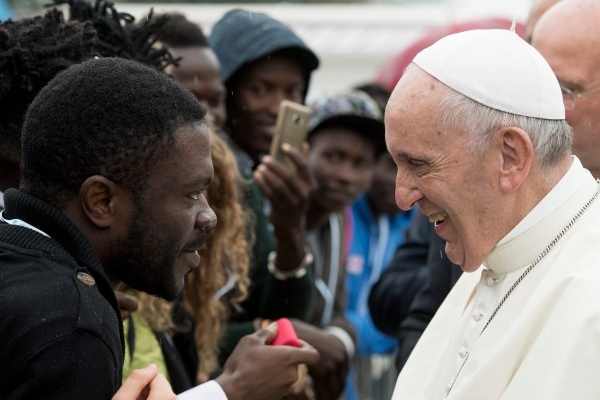
The International Catholic Migration Commission (ICMC) is marking 70 years in its outreach to protect and serve uprooted people, whether refugees, asylum-seekers, internally displaced people, victims of human trafficking, and migrants, regardless of faith, race, ethnicity or nationality.
By Vatican News staff writer
Over the past week media reports have increased over tragedies regarding migrants and refugees fleeing their homelands in makeshift boats trying to get to Europe. One of the latest came in on Saturday when a boat was reported to have capsized off the coast of Dakhla, Maroccoo, in the Western Sahara region, where dozens are believed to be missing and feared dead. The International Organization for Migration estimates that more than 1,140 persons have died this year alone in trying to migrate to Europe from countries such as Libya and Tunisia.
While the situation in Europe concerning migration receives wide coverage, the reality is global. Many Catholic aid organizations are assisting by providing emergency help and long term settlement services for migrants and refugees. A top Catholic organization working in this field is the International Catholic Migration Commission or ICMC based in Geneva which brings together the outreach of the national member organizations of bishops conferences around the globe. The ICMC protects and serves uprooted people, including refugees, asylum-seekers, internally displaced people, victims of human trafficking, and migrants, regardless of faith, race, ethnicity or nationality.
Monsignor Robert Vitillo is ICMC Secretary General and gave the following interview to Vatican News about this outreach and service.
In recent days over 800 migrants have been rescued in the Tyrrhenian sea, but NGO Rescuers are unable to bring them ashore. How would you characterize this reality and the trend of increasing persons on the move, whether in Europe or in other parts of the world?
First of all, it’s true that this is happening in Europe. It also takes place all over the world, with migrants and refugees losing their lives at sea, in deserts, and in cold mountainous regions. Regrettably, we are not always aware of this fact if we only follow the news in Europe or in higher-income countries. So, these tragic deaths are a global phenomenon and are ignored by too many people.
I would say that first of all, we have to remember that migration is part of the human condition and this has been happening since prehistoric times. People are forced to flee dangerous, life-threatening persecutions and violence with the hope to find freedom for themselves and to build a new future for their families. Recognition as a “refugee,” according to the Geneva Convention of 1951, is granted to those persons who are outside their home countries and have a “well-founded fear of persecution because of his/her race, religion, nationality, membership in a particular social group or political opinion”. They are accorded special protection that is overseen by the Office of the United Nations High Commissioner for Refugees.
But there also are many other people who have been blocked in their attempts to be considered for refugee status, or who within the boundaries of their home countries have been forced to flee for many serious reasons, including gang violence, lack of the rule of law, severe climate displacement, utter lack of adequate nutrition and clean water, human trafficking, and inability to access decent work and just pay. Most often, they want to stay at home, but they know that the survival of the entire family forces them to migrate. Other times, parents feel obliged to pay smugglers and traffickers to bring their children to what they hope will be safety, freedom, and new opportunities for a dignified life.
What is ICMC doing to help whether in emergency situations or with even long-term resettlement and integration of new arrivals in host countries?
ICMC was founded 70 years ago in 1951 by Pope Pius XII and he mandated us to form a network for all Bishops’ Conferences and other Catholic-inspired organizations and institutions responding to the needs of migrants and refugees throughout the world. So, many engaged in this ICMC global network serve as the first responders in in migration-related emergencies at the national level, and even at the local diocesan and parish levels. So ICMC’s Secretariat in Geneva tries to help its members by providing updates and information on global and regional migration situations and trends, and by encouraging them to share their positive experiences and lessons learned, as well as challenges, for mutual learning and capacity-building, through our website and through our social media platforms.
In addition to our networking activities, ICMC also is engaged in direct programming in response to some very large-scale, migration and refugee-related emergencies. This is what we do directly. In these cases, we collaborate with governments, UN, and other inter-governmental organizations to assure protection and provision for basic human needs in countries responding to large-scale movements of migrants and refugees. For example, we provide humanitarian programming in Jordan, Pakistan, and Malaysia currently. There we’re offering cash assistance for food and rent, medical care, mental health and other counselling. We’re making sure that women and children have protected spaces where they could socialize without being threatened by violence or discrimination. We help the survivors of sexual and gender-based violence. In the area of education, both formal schooling in some places and informal schooling for those children and even adults who cannot access the formal school system in the places where they have sought asylum and protection. We also sponsor livelihoods, or vocational, training so that the migrants and refugees could develop skills to qualify them for jobs or even for starting their own small businesses. One of our most popular job training programs is motorcycle repair, but other programs include barbering and beautician work, rug weaving, and sewing.
We also are involved in trying to search for durable solutions. In UN terminology, there are basically three solutions for forced displacement: one is a safe and voluntary return home when it is safe to do that; the second is integration into the countries where they first sought asylum; and the third is long-term resettlement. I should say that, of all the refugees and internally displaced persons in the world, about 85 million in total, only about one percent ever has the chance to be resettled permanently in a third country. But ICMC is involved in such resettlement work; we collaborate with the United States government, and, more recently, with a number of European countries to facilitate and prepare applications for resettlement to these countries. We do the initial interviewing of these refugees, assemble the required documentation, assist government officials as they finalize security and other screening of these applications, and then help to arrange necessary medical check-ups and, when the applicants are accepted for resettlement, we arrange travel to their new homes. We also provide cultural orientation and education to the refugees about to be resettled, so that they will learn about the country that is prepared to welcome them and well as about ways to seek work, about their legal responsibilities, and about ways to best adjust to new life challenges in the resettlement countries.
ICMC also deploys legal and social protection experts to the United Nations High Commissioner for Refugees, and to UNICEF, to help these international agencies provide adequate protection and to assist the governments in these first asylum countries to evaluate the needs of the migrants and refugees and to identify those with particular vulnerabilities to be considered for third-country resettlement. Presently, we deploy these experts to some fifty countries of the world We also promote integration of migrants and refugees in host countries, by encouraging access to language training, to skills training, access to decent work, especially in countries where they are still waiting to regularize their legal status for an opportunity to be resettled in a third country.
Another area we work in is advocacy, both on the global level, especially with the United Nations High Commissioner for Refugees and the International Organization for Migration. We convene civil society organizations in the Global Forum on Migration and Development and in groups that are working to implement the Global Compact on Refugees and the Global Compact on Migrants. Certainly, integration is an important advocacy issue we’re involved in. In Europe, we have a separate organization, ICMC Europe, that organizes training and experience sharing, especially with municipalities, faith communities, non-governmental organizations and civil society throughout Europe as they explore the best ways to integrate migrants and refugees, as well as to understand better the contribution that those migrants and refugees bring to their host countries and communities. This is especially important in places like Europe where we have a large increase in the number of elderly people and a significant decrease in the number of young people. In this case, migrants and refugees can bring dynamic contributions to the economy and many other benefits for the overall wellbeing of society.
As Pope Francis often says, integration is a two-way street. It not only benefits the migrants and refugees in receiving countries, since the local populations there also are helped by the arriving refugees and migrants who bring special skills, culture, faith and traditional and family values with them; thus, then newcomers strongly contribute to the society that’s welcoming them.
How important would you say is the role of Catholic and other faith-based NGOs working in this field?
There are many actors in the field and there are even some private-sector actors like businesses that are serving refugees and migrants, but I believe that the non-governmental organizations and especially the Catholic inspired and other faith-based organizations bring a very special contribution to this field. One is that our responses are based on faith and rooted in values and, of course, we have a long tradition in the Catholic church, both the theological doctrine and our tradition of putting the Gospel into action, as we welcome and serve migrants and refugees. We’ve done that from the very beginning of our church, and as we know Jesus, Mary, and Joseph were refugees shortly after our Lord’s birth. So, in the Catholic Church, we have a shared a history and commitment to, in the words of Pope Francis, “welcome, protect, promote, and integrate” migrants, refugees, internally displaced persons and survivors of human trafficking. We’re receiving people because of the dignity that they have as sons and daughters of the one God and as sisters and brothers of our Lord Jesus Christ. We also want to be sure that they could enjoy that dignity in peace and security and bring their gifts that they receive from God our Creator and be able to offer those same gifts to the societies that are receiving them.
For those who eventually could go back home safely and voluntarily, then, if they’ve benefited from the efforts of ICMC and its members throughout the world, they bring those benefits to their countries of origin. So, I think the faith-inspired organizations come with a motivation that’s very, very special in terms of respecting the dignity of each and every person and wanting to be sure that those people have the possibility for enjoying that dignity and of contributing to the people who are welcoming them.
How would you describe the interreligious dimension and collaboration in this field?
ICMC enjoys much interreligious cooperation, as well as with other NGOs, in terms of the advocacy we do at the global level. So the convening of civil society that ICMC does at the request of various global structures is to bring together about three thousand nongovernmental organizations and to look for some common platform to encourage governments and businesses and in other parts of society to agree on in terms of just and fair refugee and migrant policies. So, we do a lot of that with other faith-based organizations as well.
Also, at the present time, most of ICMC’s direct humanitarian, protection, and resettlement services are in countries where Christians represent a minority population – in fact, in countries with a Muslim majority. And so, we work very closely with the Muslim religious leaders and other organizations in those countries to be able to serve their people and also to explore the common values that we have as people of faith. I’ll give an example. In Pakistan we are operating fifteen different health programs along the border of Pakistan and Afghanistan. Most of them are Afghan refugees and have been in the camps for two and three generations, up to 40 years. So when I visited there, I was first greeted by the Muslim religious leaders who briefed me about the situation in their camps and all of them, without one exception, told me that they were very grateful for ICMC’s services because we put the refugees at the center of our work. And that’s exactly why we do this because we believe in the dignity of every person and yet we also want to collaborate with those of other religious traditions, so that we could be sure that that dignity is respected by all people.
If you were to make an appeal, what would you ask for today?
I would have to turn to Pope Francis here because I think he has made such an appeal since the beginning of this pontificate, and it’s well within the theology and the tradition of our Church for the past two thousand years. I will repeat his four key verbs – welcome, protect, promote, and integrate. Sometimes people say that these verbs are overused, but I think they are so appropriate especially in the face of many uncertainties and much rejection that are confronted by migrants and refugees in today’s world, very much due to increasing nationalism that we see in societies all over the world. Pope Francis simply but forcefully expects to treat the “stranger” as a gift of God, which we have been taught both in the Old and New Testaments and in most of the major faith traditions. If we are open to do that, then we can make this world a much better place – a safer place for those who have had to flee, whether it was for persecution or political reasons or economic reasons and give them a chance to enjoy the dignity that they received from God himself. Secondly, we also open ourselves up to benefit from the refugees and the migrants in the world today and not simply as obliged to respond to their needs and demands. So, my appeal is not so original but is based on the leadership of Pope Francis in prioritizing the responsibility to encounter Jesus in each and every migrant and refugee and all people on the peripheries or ignored and rejected by so-called “mainstream” society.
How would you encourage Catholics to become involved in assisting or increasing their understanding of this situation?
I would encourage Catholics, first of all, to understand, and integrate into their lives of faith, the teaching of our Church in relation to migrants and refugees. Many Catholics do not seem be aware of such teaching or of our action on behalf of such migrants for more than two millennia. Also, I’ve encouraged many Catholics, who come from immigrant or refugee roots to remember how their own ancestors, even their grandparents and parents, migrated to another place, either because of persecution, or because of political unrest and civil strife, or because of a better economic possibilities. Often, the very people who today reject migrants and refugees, themselves came from another country or region of the world and received welcome in their newly adopted “home” countries.
I also think it is most important as well for us to get to know the refugees and the migrants. It’s easy to simply call them a problem or an issue or a deluge of people arriving. But, once you really get to know these people, and share with them, and understand that they have the same wants and needs and desires that we have, that they have the same gifts that we have, then of the resistance and rejection will disappear, and much more acceptance and mutual love as brothers and sisters in the one God begins to develop.
This article was published at the website of Vatican News:
Monseñor Robert Vitillo, Secretario General de la Comisión, habla de los 70 años de compromiso con los migrantes y de la urgencia de trabajar juntos, especialmente ante las últimas tragedias en el Mar Mediterráneo y en otros lugares.
Isabella Piro – Ciudad del Vaticano
Proteger y servir a los migrantes, ya sean refugiados, solicitantes de asilo, desplazados internos o víctimas de la trata de seres humanos, independientemente de su fe, raza, etnia o nacionalidad: este ha sido el compromiso de la Comisión Católica Internacional de Migración (ICMC) durante 70 años. Se trata de un organismo muy importante, teniendo en cuenta las noticias más recientes: en la última semana han aumentado los informes de los medios de comunicación sobre las tragedias de los migrantes y refugiados que huyen de sus países de origen en embarcaciones improvisadas, tratando de llegar a Europa. Basta pensar en el sábado 7 de agosto, cuando una embarcación volcó frente a la costa de Dajla (Marruecos), en la región del Sáhara Occidental, dejando decenas de muertos y muchos desaparecidos.
Estas cifras se suman a las más de 1.140 muertes estimadas por la Organización Internacional para las Migraciones entre quienes intentaron, sólo en 2021, emigrar a Europa desde países como Libia y Túnez. Se trata de una realidad mundial en la que muchas organizaciones humanitarias católicas participan en la prestación de ayuda de emergencia y servicios de asentamiento a largo plazo. Uno de ellos es el ICMC, con sede en Ginebra, que reúne a los organismos nacionales miembros de las Conferencias Episcopales de todo el mundo. Su Secretario General es Monseñor Robert Vitillo quien, en una entrevista con los colegas de habla inglesa de VaticanNews, dice: “Las trágicas muertes de los migrantes son un fenómeno global” que, por desgracia, ocurre en todo el mundo, no sólo en Europa. Sin embargo, es “ignorada por demasiada gente”.
“La migración forma parte de la condición humana desde la prehistoria -continúa Monseñor Vitillo-, las personas se ven obligadas a huir de la persecución y la violencia con la esperanza de encontrar la libertad para ellos y construir un nuevo futuro para sus familias. Además de los que han sido reconocidos como “refugiados” en virtud de la Convención de Ginebra de 1951 y supervisados por el Alto Comisionado de las Naciones Unidas para los Refugiados (ACNUR), el Presidente subrayó que hay muchos otros que siguen esperando su reconocimiento o que son “desplazados internos” en sus propios países, huyendo de la “falta de Estado de Derecho, del grave cambio climático, de la ausencia total de una nutrición adecuada y de agua potable, de la trata de seres humanos y de la falta de acceso a un trabajo decente y a una remuneración justa”. Por lo tanto, aunque quieran quedarse en su tierra natal, estas personas se ven obligadas a emigrar so pena de la supervivencia de su familia en términos de “seguridad, libertad y nuevas oportunidades para una vida digna”.
El papel del ICMC
Para todos ellos, continúa el Secretario General, la ICMC ofrece actividades de primeros auxilios a nivel nacional, diocesano y parroquial. A sus propios miembros, el organismo les proporciona actualizaciones e información sobre las tendencias migratorias mundiales y regionales, y los anima a compartir, a través de sus páginas web y redes sociales, “experiencias y retos para seguir desarrollando sus capacidades”. Fundada en 1951 por el Papa Pío XII, la Comisión Católica Internacional para las Migraciones “también participa en la programación directa en respuesta a ciertas emergencias a gran escala relacionadas con la migración”, añade Monseñor Vitillo, “en estos casos, colaboramos con los gobiernos, la ONU y otras organizaciones intergubernamentales para garantizar la protección y atender las necesidades básicas de los migrantes y refugiados”.
Trabajo realizado en todo el mundo
Entre los ejemplos más recientes, el Prelado cita los programas humanitarios llevados a cabo en Jordania, Pakistán y Malasia, a través de ayudas en metálico para la alimentación y el alquiler; atención médica y psicológica; espacios sociales seguros para los niños; apoyo a las víctimas de la violencia sexual y de género; actividades educativas para menores y adultos; formación profesional para que los inmigrantes puedan desarrollar habilidades cualificadas o iniciar pequeños negocios en el sector mecánico (reparación de motos) o textil (tejido de alfombras).
Pero el ICMC también participa en el proceso de reasentamiento de migrantes: de los 85 millones de migrantes, de hecho, explica Monseñor Vitillo, “sólo alrededor del 1% tiene la posibilidad de ser reasentado permanentemente en un tercer país”. Por ello, la Comisión colabora con los gobiernos locales de Europa y Estados Unidos “para facilitar y preparar las solicitudes de reasentamiento en estos países”. En concreto, el organismo se encarga de los contactos iniciales con los refugiados y de la preparación de la documentación requerida, asistiendo a los funcionarios del gobierno, organizando también los controles médicos necesarios y el viaje de los refugiados a sus nuevas ubicaciones, una vez aceptada la solicitud de reasentamiento. También es importante la “orientación cultural” que se proporciona a los refugiados que van a ser reasentados, para que “conozcan el país de destino, cómo buscar trabajo y sus responsabilidades legales, de modo que puedan adaptarse mejor a los nuevos retos” que les esperan.
Otros servicios prestados por el ICMC incluyen “el envío de expertos en protección jurídica y social a 50 países de todo el mundo para ayudar al ACNUR y al UNICERF en su trabajo y para apoyar a los gobiernos de los países de primer asilo en la evaluación de las necesidades de los migrantes y los refugiados, identificando a aquellos con vulnerabilidades particulares”; y “la promoción de la integración de los migrantes en los países de acogida, incluyendo el acceso a la formación lingüística, la capacitación y el acceso a un trabajo decente”. También hay un fuerte compromiso con la defensa, continúa Monseñor Vitillo, para fomentar la aplicación del Pacto Mundial sobre Refugiados y Migrantes.
Un enfoque especial en Europa
En Europa, en particular, el ICMC Europe “organiza formaciones e intercambios de experiencias, especialmente con los municipios, las comunidades religiosas, las organizaciones no gubernamentales y la sociedad civil”, con el fin de “comprender mejor la contribución que los migrantes y los refugiados aportan a las comunidades de acogida”. “Esto es particularmente importante en el continente europeo -continúa el prelado-, donde hay un gran aumento del número de personas mayores y una disminución significativa del número de jóvenes. En este caso, de hecho, los migrantes y los refugiados “pueden aportar contribuciones dinámicas a la economía y muchos otros beneficios para el bienestar general de la sociedad”, porque “como suele decir el Papa Francisco, la integración es una vía de doble sentido: los refugiados y los migrantes traen consigo habilidades especiales, cultura, fe y valores tradicionales y familiares” que “contribuyen fuertemente a la sociedad que los acoge”.
En cuanto a la especificidad de las organizaciones católicas que trabajan sobre el terreno, el prelado reitera que “nuestras respuestas están basadas en la fe y en los valores”. “En la Iglesia católica -explica- tenemos una historia compartida y un compromiso de acogida, protección, promoción e integración de los migrantes, los refugiados, los desplazados internos y los supervivientes de la trata de seres humanos, como ha indicado el Papa Francisco. Cada persona, de hecho, tiene su propia dignidad como “hijo de Dios” y debe ser acogida como tal. En este sentido, “las organizaciones inspiradas en la fe tienen una motivación muy especial en cuanto al respeto de la dignidad de cada persona y la garantía de que estas personas tengan la oportunidad de disfrutar de esa dignidad y de contribuir al pueblo que las acoge”.
Al mismo tiempo, Monseñor Vitillo destaca “la gran colaboración interreligiosa” de la que goza la ICMC a nivel mundial, con el objetivo de crear “una plataforma común con unas 3.000 ONG” para animar a los gobiernos, empresas y otros sectores de la sociedad a “ponerse de acuerdo en términos de políticas justas y equitativas para los refugiados y los migrantes”. Esto es crucial, teniendo en cuenta que “la mayor parte de los servicios humanitarios directos, de protección y de reasentamiento del CICR se encuentran en países donde los cristianos son una minoría; de hecho, en naciones de mayoría musulmana”. Por ello, la cooperación interconfesional es muy estrecha, también “para explorar los valores comunes como personas de fe”. Los ejemplos en este campo provienen de la frontera entre Pakistán y Afganistán, donde el CICR ha puesto en marcha “15 programas de salud diferentes” para los refugiados.
Los inmigrantes no deben ser considerados un problema
Ante las “incertidumbres” y el “creciente nacionalismo que vemos en las sociedades de todo el mundo”, Monseñor Vitillo recuerda la reiterada llamada del Papa a “encontrar a Jesús en cada emigrante y refugiado y en todas las personas que están en la periferia o son ignoradas y rechazadas por la sociedad llamada ‘tradicional'”. Por ello, hay que animar a los católicos a que sean más conscientes y a que “integren en su vida de fe la enseñanza de nuestra Iglesia en relación con los emigrantes y los refugiados”, porque los propios antepasados de muchos de ellos “emigraron a causa de la persecución, los disturbios políticos y las luchas civiles, o por una mejor oportunidad económica”. Por eso es importante conocer a los refugiados y a los inmigrantes, concluye el Secretario General de la ICMC, porque “es fácil llamarles simplemente ‘problema'”, pero cuando se les conoce de verdad y se entiende que “tienen los mismos deseos y necesidades que nosotros, entonces desaparecen las resistencias y el rechazo, y se empieza a desarrollar mucha más aceptación y amor mutuo, como hermanos y hermanas en el único Dios”.
Este artículo fue publicado en la página web de Vatican News:
The International Catholic Migration Commission (ICMC) is marking 70 years in its outreach to protect and serve uprooted people, whether refugees, asylum-seekers, internally displaced people, victims of human trafficking, and migrants, regardless of faith, race, ethnicity or nationality.
By Vatican News staff writer
Over the past week media reports have increased over tragedies regarding migrants and refugees fleeing their homelands in makeshift boats trying to get to Europe. One of the latest came in on Saturday when a boat was reported to have capsized off the coast of Dakhla, Maroccoo, in the Western Sahara region, where dozens are believed to be missing and feared dead. The International Organization for Migration estimates that more than 1,140 persons have died this year alone in trying to migrate to Europe from countries such as Libya and Tunisia.
While the situation in Europe concerning migration receives wide coverage, the reality is global. Many Catholic aid organizations are assisting by providing emergency help and long term settlement services for migrants and refugees. A top Catholic organization working in this field is the International Catholic Migration Commission or ICMC based in Geneva which brings together the outreach of the national member organizations of bishops conferences around the globe. The ICMC protects and serves uprooted people, including refugees, asylum-seekers, internally displaced people, victims of human trafficking, and migrants, regardless of faith, race, ethnicity or nationality.
Monsignor Robert Vitillo is ICMC Secretary General and gave the following interview to Vatican News about this outreach and service.
In recent days over 800 migrants have been rescued in the Tyrrhenian sea, but NGO Rescuers are unable to bring them ashore. How would you characterize this reality and the trend of increasing persons on the move, whether in Europe or in other parts of the world?
First of all, it’s true that this is happening in Europe. It also takes place all over the world, with migrants and refugees losing their lives at sea, in deserts, and in cold mountainous regions. Regrettably, we are not always aware of this fact if we only follow the news in Europe or in higher-income countries. So, these tragic deaths are a global phenomenon and are ignored by too many people.
I would say that first of all, we have to remember that migration is part of the human condition and this has been happening since prehistoric times. People are forced to flee dangerous, life-threatening persecutions and violence with the hope to find freedom for themselves and to build a new future for their families. Recognition as a “refugee,” according to the Geneva Convention of 1951, is granted to those persons who are outside their home countries and have a “well-founded fear of persecution because of his/her race, religion, nationality, membership in a particular social group or political opinion”. They are accorded special protection that is overseen by the Office of the United Nations High Commissioner for Refugees.
But there also are many other people who have been blocked in their attempts to be considered for refugee status, or who within the boundaries of their home countries have been forced to flee for many serious reasons, including gang violence, lack of the rule of law, severe climate displacement, utter lack of adequate nutrition and clean water, human trafficking, and inability to access decent work and just pay. Most often, they want to stay at home, but they know that the survival of the entire family forces them to migrate. Other times, parents feel obliged to pay smugglers and traffickers to bring their children to what they hope will be safety, freedom, and new opportunities for a dignified life.
What is ICMC doing to help whether in emergency situations or with even long-term resettlement and integration of new arrivals in host countries?
ICMC was founded 70 years ago in 1951 by Pope Pius XII and he mandated us to form a network for all Bishops’ Conferences and other Catholic-inspired organizations and institutions responding to the needs of migrants and refugees throughout the world. So, many engaged in this ICMC global network serve as the first responders in in migration-related emergencies at the national level, and even at the local diocesan and parish levels. So ICMC’s Secretariat in Geneva tries to help its members by providing updates and information on global and regional migration situations and trends, and by encouraging them to share their positive experiences and lessons learned, as well as challenges, for mutual learning and capacity-building, through our website and through our social media platforms.
In addition to our networking activities, ICMC also is engaged in direct programming in response to some very large-scale, migration and refugee-related emergencies. This is what we do directly. In these cases, we collaborate with governments, UN, and other inter-governmental organizations to assure protection and provision for basic human needs in countries responding to large-scale movements of migrants and refugees. For example, we provide humanitarian programming in Jordan, Pakistan, and Malaysia currently. There we’re offering cash assistance for food and rent, medical care, mental health and other counselling. We’re making sure that women and children have protected spaces where they could socialize without being threatened by violence or discrimination. We help the survivors of sexual and gender-based violence. In the area of education, both formal schooling in some places and informal schooling for those children and even adults who cannot access the formal school system in the places where they have sought asylum and protection. We also sponsor livelihoods, or vocational, training so that the migrants and refugees could develop skills to qualify them for jobs or even for starting their own small businesses. One of our most popular job training programs is motorcycle repair, but other programs include barbering and beautician work, rug weaving, and sewing.
We also are involved in trying to search for durable solutions. In UN terminology, there are basically three solutions for forced displacement: one is a safe and voluntary return home when it is safe to do that; the second is integration into the countries where they first sought asylum; and the third is long-term resettlement. I should say that, of all the refugees and internally displaced persons in the world, about 85 million in total, only about one percent ever has the chance to be resettled permanently in a third country. But ICMC is involved in such resettlement work; we collaborate with the United States government, and, more recently, with a number of European countries to facilitate and prepare applications for resettlement to these countries. We do the initial interviewing of these refugees, assemble the required documentation, assist government officials as they finalize security and other screening of these applications, and then help to arrange necessary medical check-ups and, when the applicants are accepted for resettlement, we arrange travel to their new homes. We also provide cultural orientation and education to the refugees about to be resettled, so that they will learn about the country that is prepared to welcome them and well as about ways to seek work, about their legal responsibilities, and about ways to best adjust to new life challenges in the resettlement countries.
ICMC also deploys legal and social protection experts to the United Nations High Commissioner for Refugees, and to UNICEF, to help these international agencies provide adequate protection and to assist the governments in these first asylum countries to evaluate the needs of the migrants and refugees and to identify those with particular vulnerabilities to be considered for third-country resettlement. Presently, we deploy these experts to some fifty countries of the world We also promote integration of migrants and refugees in host countries, by encouraging access to language training, to skills training, access to decent work, especially in countries where they are still waiting to regularize their legal status for an opportunity to be resettled in a third country.
Another area we work in is advocacy, both on the global level, especially with the United Nations High Commissioner for Refugees and the International Organization for Migration. We convene civil society organizations in the Global Forum on Migration and Development and in groups that are working to implement the Global Compact on Refugees and the Global Compact on Migrants. Certainly, integration is an important advocacy issue we’re involved in. In Europe, we have a separate organization, ICMC Europe, that organizes training and experience sharing, especially with municipalities, faith communities, non-governmental organizations and civil society throughout Europe as they explore the best ways to integrate migrants and refugees, as well as to understand better the contribution that those migrants and refugees bring to their host countries and communities. This is especially important in places like Europe where we have a large increase in the number of elderly people and a significant decrease in the number of young people. In this case, migrants and refugees can bring dynamic contributions to the economy and many other benefits for the overall wellbeing of society.
As Pope Francis often says, integration is a two-way street. It not only benefits the migrants and refugees in receiving countries, since the local populations there also are helped by the arriving refugees and migrants who bring special skills, culture, faith and traditional and family values with them; thus, then newcomers strongly contribute to the society that’s welcoming them.
How important would you say is the role of Catholic and other faith-based NGOs working in this field?
There are many actors in the field and there are even some private-sector actors like businesses that are serving refugees and migrants, but I believe that the non-governmental organizations and especially the Catholic inspired and other faith-based organizations bring a very special contribution to this field. One is that our responses are based on faith and rooted in values and, of course, we have a long tradition in the Catholic church, both the theological doctrine and our tradition of putting the Gospel into action, as we welcome and serve migrants and refugees. We’ve done that from the very beginning of our church, and as we know Jesus, Mary, and Joseph were refugees shortly after our Lord’s birth. So, in the Catholic Church, we have a shared a history and commitment to, in the words of Pope Francis, “welcome, protect, promote, and integrate” migrants, refugees, internally displaced persons and survivors of human trafficking. We’re receiving people because of the dignity that they have as sons and daughters of the one God and as sisters and brothers of our Lord Jesus Christ. We also want to be sure that they could enjoy that dignity in peace and security and bring their gifts that they receive from God our Creator and be able to offer those same gifts to the societies that are receiving them.
For those who eventually could go back home safely and voluntarily, then, if they’ve benefited from the efforts of ICMC and its members throughout the world, they bring those benefits to their countries of origin. So, I think the faith-inspired organizations come with a motivation that’s very, very special in terms of respecting the dignity of each and every person and wanting to be sure that those people have the possibility for enjoying that dignity and of contributing to the people who are welcoming them.
How would you describe the interreligious dimension and collaboration in this field?
ICMC enjoys much interreligious cooperation, as well as with other NGOs, in terms of the advocacy we do at the global level. So the convening of civil society that ICMC does at the request of various global structures is to bring together about three thousand nongovernmental organizations and to look for some common platform to encourage governments and businesses and in other parts of society to agree on in terms of just and fair refugee and migrant policies. So, we do a lot of that with other faith-based organizations as well.
Also, at the present time, most of ICMC’s direct humanitarian, protection, and resettlement services are in countries where Christians represent a minority population – in fact, in countries with a Muslim majority. And so, we work very closely with the Muslim religious leaders and other organizations in those countries to be able to serve their people and also to explore the common values that we have as people of faith. I’ll give an example. In Pakistan we are operating fifteen different health programs along the border of Pakistan and Afghanistan. Most of them are Afghan refugees and have been in the camps for two and three generations, up to 40 years. So when I visited there, I was first greeted by the Muslim religious leaders who briefed me about the situation in their camps and all of them, without one exception, told me that they were very grateful for ICMC’s services because we put the refugees at the center of our work. And that’s exactly why we do this because we believe in the dignity of every person and yet we also want to collaborate with those of other religious traditions, so that we could be sure that that dignity is respected by all people.
If you were to make an appeal, what would you ask for today?
I would have to turn to Pope Francis here because I think he has made such an appeal since the beginning of this pontificate, and it’s well within the theology and the tradition of our Church for the past two thousand years. I will repeat his four key verbs – welcome, protect, promote, and integrate. Sometimes people say that these verbs are overused, but I think they are so appropriate especially in the face of many uncertainties and much rejection that are confronted by migrants and refugees in today’s world, very much due to increasing nationalism that we see in societies all over the world. Pope Francis simply but forcefully expects to treat the “stranger” as a gift of God, which we have been taught both in the Old and New Testaments and in most of the major faith traditions. If we are open to do that, then we can make this world a much better place – a safer place for those who have had to flee, whether it was for persecution or political reasons or economic reasons and give them a chance to enjoy the dignity that they received from God himself. Secondly, we also open ourselves up to benefit from the refugees and the migrants in the world today and not simply as obliged to respond to their needs and demands. So, my appeal is not so original but is based on the leadership of Pope Francis in prioritizing the responsibility to encounter Jesus in each and every migrant and refugee and all people on the peripheries or ignored and rejected by so-called “mainstream” society.
How would you encourage Catholics to become involved in assisting or increasing their understanding of this situation?
I would encourage Catholics, first of all, to understand, and integrate into their lives of faith, the teaching of our Church in relation to migrants and refugees. Many Catholics do not seem be aware of such teaching or of our action on behalf of such migrants for more than two millennia. Also, I’ve encouraged many Catholics, who come from immigrant or refugee roots to remember how their own ancestors, even their grandparents and parents, migrated to another place, either because of persecution, or because of political unrest and civil strife, or because of a better economic possibilities. Often, the very people who today reject migrants and refugees, themselves came from another country or region of the world and received welcome in their newly adopted “home” countries.
I also think it is most important as well for us to get to know the refugees and the migrants. It’s easy to simply call them a problem or an issue or a deluge of people arriving. But, once you really get to know these people, and share with them, and understand that they have the same wants and needs and desires that we have, that they have the same gifts that we have, then of the resistance and rejection will disappear, and much more acceptance and mutual love as brothers and sisters in the one God begins to develop.
This article was published at the website of Vatican News: